|
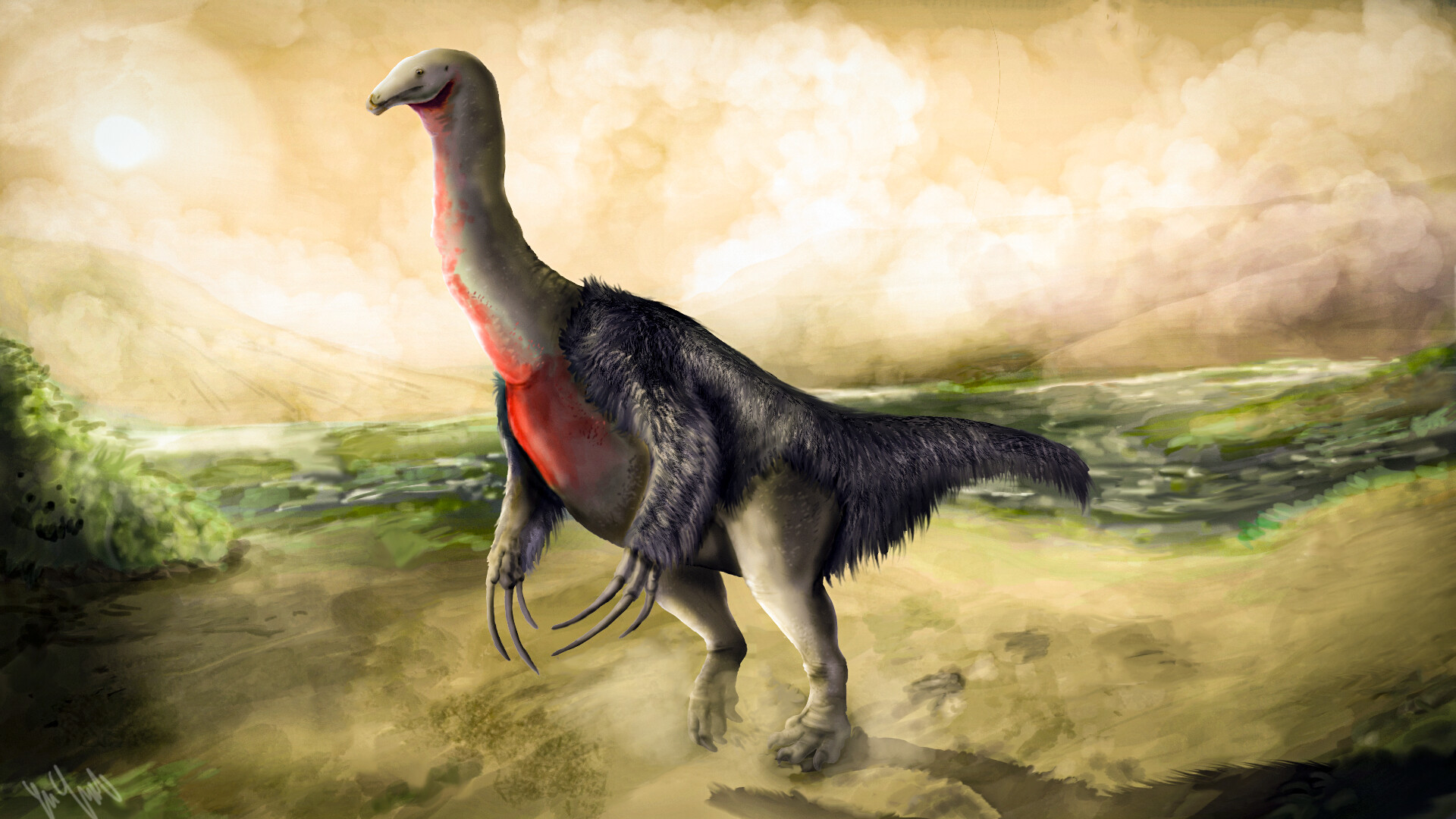
Therizinosaurus by Ivan Iofrida |
With long arms and sharp claws, Therizinosaurus
has almost all the character traits of a predator, however, this dinosaur was
an herbivore.
Therizinosaurus
is a theropod, the dinosaur family that includes T. rex, Allosaurus,
dromeosaurs, and even birds. But unlike most of its non-avian cousins,
Therizinosaurus evolved to have a mostly plant-based diet.
A lot like
panda bears, which have traded a predator lifestyle for bamboo leaves while
retaining most of the characteristics that make them part of the bear family,
Therizinosaurus kept a set of strong arms ending in very long and sharp claws.
This made
this dinosaur one of the most bizarre and also one of the most capable of
defending itself against a predator. Bumping into a Therizinosaurus in the
middle of a dark forest would most likely be as terrifying as stumbling into a
T. rex’s nest.
No longer a turtle
Therizinosaurus
fossils were first found in 1948 by a team of soviet paleontologists exploring
the Nemegt Formation of the Gobi Desert in Mongolia.
This
expedition found a great deal of dinosaur and turtle fossil remains, but the
most noteworthy find was three sizeable incomplete claw bones in combination
with other objects including a metacarpal fragment and multiple rib pieces in
close proximity to a big theropod's skeleton.
The fossils
were given the specimen number PIN 551-483 and later used as the basis for the
new genus and type species Therizinosaurus
cheloniformis, which became the holotype specimen, described by the Russian
paleontologist Evgeny Maleev in 1954.
The name Therizinosaurus,
which refers to this animal’s enormous claws, is derived from the Greek words
therzo, which means scythe, reap, or cut, and sauros, which means lizard. The
specific name cheloniformis, which refers to the remains, is derived from the
Greek word chelóni, which means turtle, and the Latin formis, since the remains
were thought to belong to a turtle-like reptile.
However, in
1970 another Russian paleontologist named Anatoly K. Rozhdestvensky, had a
better look into these fossils and suggested that Therizinosaurus was in fact a
theropod dinosaur and not a turtle, by comparing its claw bones with those of
other meat-eating dinosaurs.
New fossil
findings of this animal and of other species closely related to Therizinosaurus,
like Segnosaurus and Nothronychus, further supported this claim, making this
dinosaur the first of a new family called Therizinosauridae.
A not-so-gentle giant
 |
| Mounted forelimbs of specimen MPC-D 100/15 at Nagoya City Science Museum |
Although
new fossil remains have been found, Therizinosaurus is to this day one of the most
incomplete members of this group. The most complete remains only include bones
of its forelimbs, claws, some ribs, and its hindlimbs, and we have yet to find
its skull.
Taking this
data into account, and looking at other members of this group, paleontologists
have managed to determine that Therizinosaurus would have reached 9 to 10 meters
(30 to 33 ft) in length with an estimated height of 4 to 5 meters (13 to 16 ft)
and a weight from 3 to 5 metric tons (3.3 to 5.5 short tons).
But one of
the most fascinating things about this animal was its diet. In 1993, Canadian paleontologists
Dale and Donald Russell compared Therizinosaurus and Chalicotherium, an extinct
large ungulate mammal known for walking on its knuckles. This team identified
some similarities in both animals’ body plans.
Both Therizinosaurus
and Chalicotherium had large, well-developed, and relatively strong arms, a robust
pelvic girdle suited for a sitting behavior, and robust and shortened hindlimbs.
Dale and
Donald considered these adaptations to represent an example of convergent evolution,
which happens when different organisms evolve similar traits without being
related. An example of this is sharks, dolphins, and ichthyosaurs, evolving a
very similar body plan in spite of being separated by hundreds of millions of years
of evolution, and belonging to different clades.
Since animals
with this type of body plan are known to represent herbivores, the authors
suggested this lifestyle for Therizinosaurus. Dale and Donald Russell
reconstructed the feeding behavior of Therizinosaurus as being able to sit
while consuming foliage from large shrubs and trees, using its arms to pull the
branches towards itself, and its long neck to feed on the leaves without having
to stand.
When
browsing in a bipedal stance, Therizinosaurus may have been able to reach even
higher vegetation supported by its short and robust feet. Whereas
Chalicotherium was more suited to hook branches, Therizinosaurus was better at
pushing large clumps of foliage because of its long claws.
In 2018,
paleontologist Anthony R. Fiorillo suggested that Therizinosaurus had a reduced
bite force that may have been useful for cropping vegetation or foraging. This hypothesis
was suggested based on an analysis of other therizinosaurids such as
Erlikosaurus and Segnosaurus.
A Jurassic star is born
 |
| Claire Dearing (Bryce Dallas Howard) is being chased by a Therizinosaurus in Jurassic World Dominion |
Therizinosaurus
has recently risen to fame, being one of the new dinosaur stars of Jurassic
World Dominion. But how accurate was this dinosaur’s depiction in the new movie?
Although
the fossil remains of Therizinosaurus are relatively incomplete, its physical
characteristics can be inferred through more complete and related
therizinosaurids.
Paleontologists
believe that like other members of its family, Therizinosaurus had a
proportionally small skull bearing a horny beak atop its long neck, a bipedal
gait, a large belly to process its plant-based diet, and it was most likely covered
in feathers.
Jurassic
World Dominion’s interpretation of this animal is inspired by most of these
traits.
It’s a bit
larger than the real animal, having 12 meters (40 ft) in length and 6 meters
(20 ft) in height, which is not unusual for this franchise.
This animal
was in fact covered in feathers and it’s not unlikely that it might have acted aggressively
towards an unknown threat.
Where
Jurassic World Dominion seems to have dropped the ball is with this dinosaur’s
head sculpt. The beak is too birdlike and its snout is too short, but overall
it is one of the most accurate dinosaur designs in the latest installment of
this franchise.
Being a
theropod, Therizinosaurus most likely would have had acute eyesight, a trait
that this animal would’ve needed to detect predators and other threats and to find
food and other members of its species.
In this
movie this dinosaur is portrayed as being blind, however, this seems to be due
to an incident that happened off-screen involving that particular animal, and
not a characteristic common to all in-world Therizinosaurus.
Therizinosaurus was an odd and fascinating dinosaur that questioned our understanding of theropod evolution. Its discovery opened up a new wave of research for paleontologists and other scientists interested in the ecology of this long-lost world.