Sunday, July 31, 2022

Therizinosaurus: The Panda bear of the Cretaceous

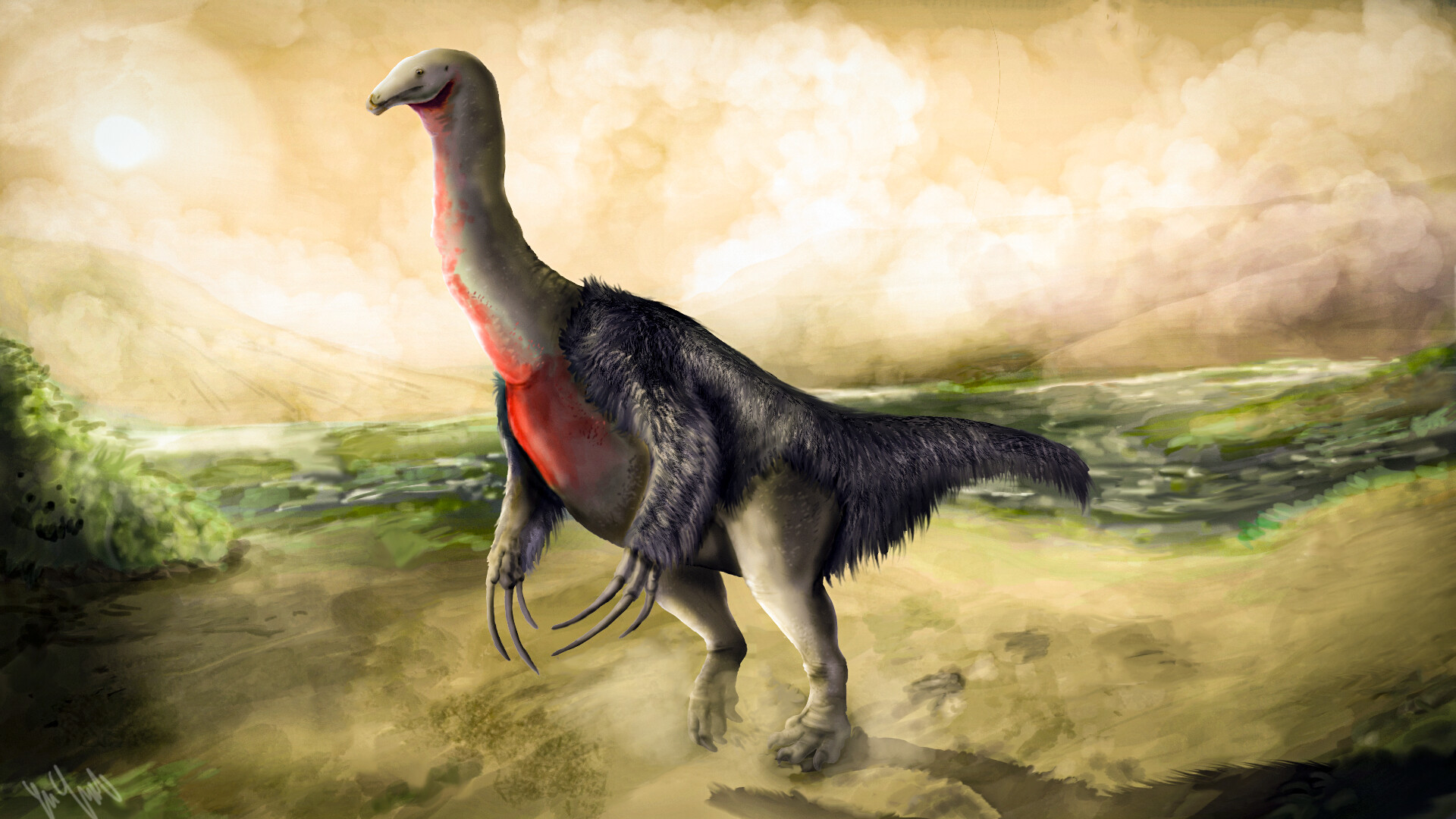
Therizinosaurus by Ivan Iofrida

With long arms and sharp claws, Therizinosaurus has almost all the character traits of a predator, however, this dinosaur was an herbivore.

Therizinosaurus is a theropod, the dinosaur family that includes T. rex, Allosaurus, dromeosaurs, and even birds. But unlike most of its non-avian cousins, Therizinosaurus evolved to have a mostly plant-based diet.

A lot like panda bears, which have traded a predator lifestyle for bamboo leaves while retaining most of the characteristics that make them part of the bear family, Therizinosaurus kept a set of strong arms ending in very long and sharp claws.

This made this dinosaur one of the most bizarre and also one of the most capable of defending itself against a predator. Bumping into a Therizinosaurus in the middle of a dark forest would most likely be as terrifying as stumbling into a T. rex’s nest.

No longer a turtle

Therizinosaurus fossils were first found in 1948 by a team of soviet paleontologists exploring the Nemegt Formation of the Gobi Desert in Mongolia.  

This expedition found a great deal of dinosaur and turtle fossil remains, but the most noteworthy find was three sizeable incomplete claw bones in combination with other objects including a metacarpal fragment and multiple rib pieces in close proximity to a big theropod's skeleton.

The fossils were given the specimen number PIN 551-483 and later used as the basis for the new genus and type species Therizinosaurus cheloniformis, which became the holotype specimen, described by the Russian paleontologist Evgeny Maleev in 1954.

The name Therizinosaurus, which refers to this animal’s enormous claws, is derived from the Greek words therzo, which means scythe, reap, or cut, and sauros, which means lizard. The specific name cheloniformis, which refers to the remains, is derived from the Greek word chelóni, which means turtle, and the Latin formis, since the remains were thought to belong to a turtle-like reptile.

However, in 1970 another Russian paleontologist named Anatoly K. Rozhdestvensky, had a better look into these fossils and suggested that Therizinosaurus was in fact a theropod dinosaur and not a turtle, by comparing its claw bones with those of other meat-eating dinosaurs.

New fossil findings of this animal and of other species closely related to Therizinosaurus, like Segnosaurus and Nothronychus, further supported this claim, making this dinosaur the first of a new family called Therizinosauridae.

A not-so-gentle giant


Mounted forelimbs of specimen MPC-D 100/15 at Nagoya City Science Museum

Although new fossil remains have been found, Therizinosaurus is to this day one of the most incomplete members of this group. The most complete remains only include bones of its forelimbs, claws, some ribs, and its hindlimbs, and we have yet to find its skull.

Taking this data into account, and looking at other members of this group, paleontologists have managed to determine that Therizinosaurus would have reached 9 to 10 meters (30 to 33 ft) in length with an estimated height of 4 to 5 meters (13 to 16 ft) and a weight from 3 to 5 metric tons (3.3 to 5.5 short tons).

But one of the most fascinating things about this animal was its diet. In 1993, Canadian paleontologists Dale and Donald Russell compared Therizinosaurus and Chalicotherium, an extinct large ungulate mammal known for walking on its knuckles. This team identified some similarities in both animals’ body plans.

Both Therizinosaurus and Chalicotherium had large, well-developed, and relatively strong arms, a robust pelvic girdle suited for a sitting behavior, and robust and shortened hindlimbs.

Dale and Donald considered these adaptations to represent an example of convergent evolution, which happens when different organisms evolve similar traits without being related. An example of this is sharks, dolphins, and ichthyosaurs, evolving a very similar body plan in spite of being separated by hundreds of millions of years of evolution, and belonging to different clades.

Since animals with this type of body plan are known to represent herbivores, the authors suggested this lifestyle for Therizinosaurus. Dale and Donald Russell reconstructed the feeding behavior of Therizinosaurus as being able to sit while consuming foliage from large shrubs and trees, using its arms to pull the branches towards itself, and its long neck to feed on the leaves without having to stand.

When browsing in a bipedal stance, Therizinosaurus may have been able to reach even higher vegetation supported by its short and robust feet. Whereas Chalicotherium was more suited to hook branches, Therizinosaurus was better at pushing large clumps of foliage because of its long claws.

In 2018, paleontologist Anthony R. Fiorillo suggested that Therizinosaurus had a reduced bite force that may have been useful for cropping vegetation or foraging. This hypothesis was suggested based on an analysis of other therizinosaurids such as Erlikosaurus and Segnosaurus.

A Jurassic star is born


Claire Dearing (Bryce Dallas Howard) is being chased by a Therizinosaurus in Jurassic World Dominion

Therizinosaurus has recently risen to fame, being one of the new dinosaur stars of Jurassic World Dominion. But how accurate was this dinosaur’s depiction in the new movie?

Although the fossil remains of Therizinosaurus are relatively incomplete, its physical characteristics can be inferred through more complete and related therizinosaurids.

Paleontologists believe that like other members of its family, Therizinosaurus had a proportionally small skull bearing a horny beak atop its long neck, a bipedal gait, a large belly to process its plant-based diet, and it was most likely covered in feathers.

Jurassic World Dominion’s interpretation of this animal is inspired by most of these traits.

It’s a bit larger than the real animal, having 12 meters (40 ft) in length and 6 meters (20 ft) in height, which is not unusual for this franchise.

This animal was in fact covered in feathers and it’s not unlikely that it might have acted aggressively towards an unknown threat.

Where Jurassic World Dominion seems to have dropped the ball is with this dinosaur’s head sculpt. The beak is too birdlike and its snout is too short, but overall it is one of the most accurate dinosaur designs in the latest installment of this franchise.

Being a theropod, Therizinosaurus most likely would have had acute eyesight, a trait that this animal would’ve needed to detect predators and other threats and to find food and other members of its species.

In this movie this dinosaur is portrayed as being blind, however, this seems to be due to an incident that happened off-screen involving that particular animal, and not a characteristic common to all in-world Therizinosaurus.

Therizinosaurus was an odd and fascinating dinosaur that questioned our understanding of theropod evolution. Its discovery opened up a new wave of research for paleontologists and other scientists interested in the ecology of this long-lost world.   

Sunday, July 17, 2022

Quetzalcoatlus: A pterosaur as tall as a giraffe that hunted dinosaurs

Mark Witton and Darren Naish (2008)

Were these flying reptiles really as big as an airplane? How did such a large animal conquer the skies?

Imagine a stork the size of a giraffe hunting dinosaurs. This may sound like something from the pages of a science fiction novel, but it’s not. From 108 to 66 million years ago the skies of the Cretaceous were dominated by a group of giant flying reptiles called Azhdarchids, and one of the biggest known members of this family was Quetzalcoatlus.

Discovered in 1971 in Texas by a geology grad student named Douglas A. Lawson, this giant pterosaur was named after Quetzalcoatl, the Aztec feathered serpent god. With a wing span of 11 meters (36 ft) and a height estimate of 5,5 meters (18 ft), this was one of the biggest animals to have ever flown. It was as tall as a giraffe with a wing span similar to that of a Cessna 172 aircraft.

Although it was a big animal more recent weight estimates put it at around 200 to 250 kg (440 to 550 lb), making it somewhat of a lightweight, which would be perfect for flying.

Scientists are still discussing whether or not Quetzalcoatlus was able of long-range extended flight, with some studies even arguing that large azhdarchids only would have flown occasionally and for short distances. The debate is still going on, although the consensus seems to be leaning more to the idea that Quetzalcoatlus would be able to fly for long distances and perhaps even across continents.

Quetzalcoatlus lived in North America right at the end of the Cretaceous, sharing its environment with large long-necked titanosaurs like Alamosaurus, the oviraptorosaur Ojoraptorsaurus, the hadrosaurid Kritosaurus, the armored nodosaur Glyptodontopelta, ceratopsids like Torosaurus, Bravoceratops, and Ojoceratops, and even some yet to be described members of the Tyrannosaur family.

In fact, Alamosaurus was so common in this environment that paleontologists believe Quetzalcoatlus might have hunted hatchlings and even juveniles of this species of long-necked dinosaurs.

Like other pterosaurs, Quetzalcoatlus was covered in pycnofibers, short and simple structures similar to feathers that would have covered its body with fuzz. Its skull was bout 2,5 meters long (8.2 ft), it had a very sharp and pointed beak, as well as a head crest, the size of which is still unknown.

How accurate was the Quetzalcoatlus in Jurassic World Dominion?

Quetzalcoatlus has featured in some of the most popular works of paleo media, such as Walking With Dinosaurs, Prehistoric Planet, and Jurassic World Dominion. In the latest installment of the Jurassic World franchise, we see this giant pterosaur attack and crash an airplane, stranding Owen Grady, Claire Dearing, and Kayla Watts in the BioSyn dinosaur sanctuary.

As is often common with the prehistoric animals represented in Jurassic World, this Quetzalcoatlus was just way too big. In the movie, this animal had a wingspan of about 21 meters (50 ft), making it almost double the size of its real-life counterpart. This size estimate was actually at one point suggested, however, more recent research has put this animal’s max wing span at about 11 meters (36 ft).

Although birds have been known to shut airplane engines down after flying into them, it’s highly unlikely that an attack from a Quetzalcoatlus from above would be strong enough to crash a plane. If this pterosaur had flown into one or two of the propellers, it would have made for a more plausible scene, granted with a considerably lower dramatic effect.

Other than that, its depiction is fairly accurate, especially if we take into consideration the scene in Jurassic World Dominion’s prologue where we are first introduced to this giant azhdarchid. The way it moved on the ground, the size and shape of its beak and head crest, and even the pycnofibers covering its body, make it one of the most accurate designs in this film.

Pterosaurs vs. Dinosaurs

One common mistake in popular media is pairing pterosaurs and dinosaurs together as belonging to the same family. Although dinosaurs and pterosaurs are both archosaurs and probably shared an ancestor, both lineages diverged from each other at the beginning of the Triassic.

Pterosaurs were a very diverse family, from the small Nemicolopterus, with a wing span of only 25 centimeters (10 inches), to the weird short-tailed Anurognathus, and from the beautifully crested Tapejara from Brazil, to the famous Pteranodon. These animals were the first vertebrates to conquer the skies, first evolving 228 million years ago in the Late Triassic, and becoming extinct along with the non-avian dinosaurs, 66 million years ago.

Azhdarchids were late arrivals to this evolutionary story, but their size and their range across prehistoric Earth made them one of the most successful families of pterosaurs.

Saturday, July 09, 2022

Giganotosaurus: Was this the apex predator of its time?

Gigantosaurus in Jurassic World Dominion

Was Giganotosaurus the biggest carnivore that the World has ever seen? And how would it compare to a T. rex?

The main dinosaur antagonist in Jurassic World Dominion, Giganotosaurus, was marketed throughout the movie as the biggest carnivore that the World has ever seen. A claim that was given strength by this franchise's main paleontologist, and fan favourite, Dr. Alan Grant.

Giganotosaurus was first featured in Jurassic World Dominion's prologue, a short film released in theatres as an IMAX-exclusive before the showing of Fast 9. In this prologue, we travel back to the late cretaceous of North America, 66 million years ago, where we see several dinosaurs in their natural environment, like Dreadnoughtus, Nasutoceratops, and Oviraptor, and where we are first introduced to the giant azhdarchid Quetzalcoatlus.

At the end of this prehistoric journey, we witness a fight between a Giganotosaurus and a feathered T. rex. The Giganotosaurus manages to beat the tyrant lizard king, leaving it to die at the base of a river. We then see a mosquito biting the fallen T. rex and are brought back to our World, where the T. rex from the original Jurassic Park is being chased by a helicopter after escaping from Lockwood Manor. Giving us a hint that this animal was cloned from the DNA extracted by the same mosquito that bit the fallen T. rex, 66 million years ago.

There are many issues with this short film but the main one is that Giganotosaurus and T. rex would have never met. Giganotosaurus, whose name means giant southern lizard, lived during the Late Cretaceous, approximately 99,6 to 97 million years ago, while Tyrannosaurus rex lived from 68 to 66 million years ago. This means both animals were separated by more than 30 million years.

If time wasn't enough, both animals lived on opposite sides of the globe. While T. rex lived in North America, Giganotosaurus fossils have been discovered in the Candeleros Formation of Patagonia, in Argentina. Two continents that, at the time, were separated by a large ocean, meaning that even if both animals had lived at the same time, the likelihood of them ever meeting would be very low.

Giganotosaurus vs. T. rex


Giganotosaurus vs. T. rex in Jurassic World Dominion

Although the first T. rex fossils were found in 1874 by Arthur Lakes near Golden, Colorado, we would have to wait 30 more years for Henry Fairfield Osborn, president of the American Museum of Natural History, to in 1905 give this animal the name that would catapult it to stardom.

But, how big was a T. rex? One of the largest and the most complete specimens was Sue (FMNH PR2081), which can currently be seen at the Field Museum of Natural History, in Chicago. Sue measures about 12,4 meters in length (40.7 ft), 3,96 meters (13 ft) in height, and has been estimated to have a mass of about 8,4 metric tons (9.3 short tons).

However, the title of biggest T. rex ever found belongs to a specimen nicknamed Scotty (RSM P2523.8), located at the Royal Saskatchewan Museum. Scotty is reported to measure about 13 meters (43 ft) in length, with an estimated mass of 8,87 metric tons (9.78 short tons).

Discovered by Rubén D. Carolini in 1993, Giganotosaurus was one of the largest known terrestrial carnivores, however, its exact size has been hard to determine due to the fact that paleontologists have yet to find a complete specimen.

The skeleton of Giganotosaurus holotype specimen (MUCPv-Ch1) was about 70% complete and included the skull, pelvis, leg bones, and most of the backbone. A holotype is a single physical example of an organism, living or extinct, known to have been used when the species was first formally described.

Scientists estimate that MUCPv-Ch1 measured about 12,5 meters (41 ft) in length, with a body mass of 6,6 metric tons (7.3 short tons). However, a second specimen (MUCPv-95) has also been discovered. Although this specimen's remains are more fragmentary than the holotype's, it is estimated that this individual was about 13,2 meters (43.3 ft) long, with a mass between 7 and 8 metric tons (7.7 and 8.8 short tons).

Giganotosaurus also had one of the longest known skulls for a theropod dinosaur, with the holotype's skull estimated at 1,80 meters (5.8 ft) and the second specimen's estimated at 1,95 meters (6.3 ft). The largest known T. rex skull measures about 1,52 meters (5 ft) in length.

This means that Giganotosaurus would surpass T. rex in length by less than half a meter, however T. rex would've been a more massive animal, weighing almost one metric ton more than Giganotosaurus.

In fact, Spinosaurus would probably be a better contender for the title of biggest carnivore the World has ever seen, with a skull 1,75 meters (6 ft) long, a length of 14 meters (46 ft), and an estimated mass of 7,4 metric tons (8.2 short tons).

However, with Spinosaurus evolving to adapt to a semiaquatic lifestyle, its jaws were better equipped to hunt fish rather than fight off large theropods, dropping Jurassic Park III's main star to last place.

But when it comes to T. rex and Giganotosaurus, their size would put both animals as the apex predators of their own ecosystems.

As for who would win in a fight? My money is on our not-so-friendly neighbourhood tyrant lizard king.

Saturday, July 02, 2022

We need to talk about the locusts

Jurassic World Dominion Locust Animatronic, Image Source: DR

One of the main and most controversial plot points in Jurassic World Dominion is the use of genetically modified locusts with ancient DNA to ravage crops that were not planted using seeds sold by Biosyn, a genetics company, and the main antagonist of the movie.

Lewis Dodgson, the head of Biosyn, had the idea to use these locusts to destroy the competition and ensure that farmers only bought seeds sold by his company. However, things don’t go according to plan and the genetically modified locusts get out of control and start ravaging crops all across North America.

The remainder of the film then revolves around finding a solution to end this plague of biblical proportions before it manages to consume the World’s food supply.

So, are these locusts based on any real extinct species? Can we genetically modify insects? And does the solution cooked up by Dr. Henry Wu have any real World science to back it up?

How to become a fossil in four easy steps

Insects, and invertebrates in general, have a very incomplete fossil record, filled with gaps at times spanning hundreds of millions of years. In fact, we are lucky that some species have managed to fossilize at all.

This happens because insects are small and their bodies are too fragile to be preserved as fossils. However, insects do have a tough external skeleton that, under the right conditions, can be preserved as fossils.

The process of fossilization requires a very specific set of steps and conditions that actually makes it rare for an animal, regardless of its size, to fossilize. First, we need the animal to die close to a water source, like a lake, a swamp, a slow-moving river, or the sea bed, and for it to be buried quickly in a sedimentary basin before the natural process of decomposition begins, and before its body gets the chance to be eaten by scavengers.

For better preservation, a low oxygen environment is your best option. Then, as time passes the sedimentary basin hardens into rock and the bones are replaced with minerals, giving us an imprint of the animal.

Since insects are very small they would have to be buried very quickly in a low oxygen environment with minimal bacteria, in order to guarantee their bodies are not decomposed.

When paleontologists find a sedimentary deposit that exhibits exceptionally well-preserved fossils they call it a Lagerstätte, a German word that aptly means ‘a place of storage’.

One of the most famous fossils found in a Lagerstätte deposit was Archaeopteryx, discovered in 1861 in limestone deposits near Solnhofen, in Germany. Known as the first bird, Archaeopteryx was so well-preserved, that it still had most of its feathers, making it one of the earliest fossil evidence of the relation between dinosaurs and birds.

And, as popularized by the original Jurassic Park, insects can also be preserved in amber. Amber is fossilized tree resin that, like other fossils, was quickly buried in a layer of sediment before it could decompose, preserving everything that got trapped inside it.

Unlike what is said in the movie, however, being preserved in amber actually accelerates DNA degradation. Sorry, that mosquito may look like it had just finished feeding on the closest dinosaur, but whatever dino-DNA it may have carried is now long gone.

Even though a high number of improbable steps need to be taken for an insect to fossilize, paleontologists have in fact found quite a few in the last two centuries.

And locusts just happen to be one of those lucky specimens.

Prehistoric Locusts

Locusts, grasshoppers, and crickets belong to an order of insects called orthoptera, meaning ‘straight wings’. This order is divided into two suborders, ensifera, which includes crickets, katydids, and other insects, and caelifera, which includes locusts and grasshoppers.

Fossil and genetic data suggest that these two suborders split right at the end of the Permian, 250 million years ago, making them contemporaries of Lystrosaurus and other therapsids, mammalian ancestors that are also featured in the latest installment of the Jurassic World franchise.

Just recently a 300 million-year-old fossil locust was found in São Pedro da Cova, Portugal. Named Lusitadischia sai, this new species is now one of the oldest known members of this insect family. Its size was, however, rather modest, when compared with some of the monstrous insects of the Carboniferous, only growing to about 6 centimeters (2 in) in length.

In Jurassic World Dominion Biosyn’s genetically modified locusts were as big as a common house cat. The biggest locust alive today is the hedge grasshopper (Valanga irregularis) also known as the giant grasshopper. It’s native to Australia and females can grow up to 9 cm (3.5 in) long, about a third the size of the ones featured in this film. What about their dinosaur-aged ancestors?

Most modern families of locusts such as Eumastacidae, Tetrigidae, and Tridactylidae appeared during the Cretaceous, meaning that the locusts featured in the film did have ancient counterparts during the reign of the dinosaurs. These however were not very impressive in size.

Insects are not very effective in the way they transport oxygen from the air to their organs, meaning that their size is highly dependent on the oxygen levels in the atmosphere. For most of the Mesozoic, and particularly during the Cretaceous, oxygen levels on Earth were closer to what they are today, meaning that most insects, including locusts and grasshoppers, couldn’t grow much larger than modern species.

In the movie we also see these locusts flying in a large swarm spreading through several miles over the continental US. In 1954 the Desert Locust (Schistocerca gregaria) ravaged Kenya in a swarm that covered over 200 square kilometers (77 square miles).

It’s hard to tell if ancient locusts swarmed like they do today since this behavior is not one that would fossilize well. However, the similarities between modern and Mesozoic species give scientists enough evidence to conclude that swarming behavior was probably well established during the Cretaceous.

You never had control, that’s the illusion!

In Jurassic World Dominion Dr. Henry Wu’s solution to deal with the swarm of Biosyn locusts is to introduce into the wild locusts with a special genetic trigger that could spread throughout the swarm and kill every single one of them.

This is actually based in real-world science. Today there are genetically modified mosquitoes that are introduced into the environment to stop the spread of certain species of mosquitoes that carry infectious diseases such as malaria, zika, or yellow fever.

These mosquitoes are created by irradiating the males, using ionized radiation, which makes them sterile. These males are then released to mate with wild females, which would then lay sterile eggs that do not hatch, thus reducing the mosquito population.

Dr. Wu’s method is a bit more convoluted but its end results are the same.

As we have previously seen in this franchise, the science behind Jurassic World Dominion isn’t always as accurate as one can find in nature documentaries such as the recently released Prehistoric Planet. However, some of the concepts seen throughout this film are clearly based on the latest developments in the fields of paleontology and genetics, shining a light on issues that are currently being discussed in the scientific community.

To summarize, although ancient giant locusts the size of your typical house cat have yet to be discovered, swarms of locusts have been known to ravage entire continents, as recently as 2020, and genetic modification of animals and plants has become a common practice.

Unlike Lewis Dodgson, scientists are developing new technology to prevent these plagues from happening and to guarantee that our crop yields are enough to feed the whole World. Let’s just hope that a company as evil as Biosyn never leaves the fictional universe of Jurassic World Dominion.

Thursday, June 16, 2022

What is a Dimetrodon and why it’s wrong to call it a Dinosaur?

Dimetrodon DR

If you search through your old toy chest that your parents were careful enough to save, you might find among your dinosaur toys a small lizard-like animal with a sail on its back and a menacing grin.

This animal is called a Dimetrodon and it’s not a Dinosaur. In fact, it’s more closely related to us than it is to a T. rex or a Triceratops.

Then why do so many people confuse it with a Dinosaur? As with many misconceptions in the World of paleontology, this one has its roots in popular media, with the latest installment of the Jurassic Park franchise, Jurassic World Dominion, being the latest in a long list of movies and TV series showing this animal living alongside dinosaurs and pterosaurs (which are also not dinosaurs, but we’ll get into that in another article).

Dimetrodon was part of a group of animals called the synapsids, with its fossils being found all over the northern hemisphere from the US to Germany. Dimetrodon actually predates the dinosaurs by over 40 million years. It lived in the Permian period from 295 to 272 million years ago, going extinct even before the Great Dying, a massive extinction-level event that wiped out 90% of all life on Earth, marking the end of the Permian period and the beginning of the Triassic, 252 million years ago.

Synapsids are one of the two major groups of animals that evolved from basal amniotes, a clade of tetrapod (meaning four-legged) animals that comprise both the synapsids (mammals and their relatives) and the sauropsids (reptiles, dinosaurs, and birds).

One of the main characteristics that distinguish synapsids from other animals is that they have a temporal fenestra, an opening low in the skull roof behind each eye, leaving a bony arch beneath them. Paleontologists believe this distinctive trait developed around 318 million years ago during the late Carboniferous period when synapsids and sauropsids diverged.

(A little side note, it’s from the Carboniferous period that most of the coal used to power the industrial revolution came from. A topic for another day)

And Dimetrodon fossils have this distinct trait, making them not necessarily a mammal ancestor, but a close relative to us and to all other mammal species alive today.

Dimetrodon is actually a genus name comprising about 13 known species, the largest of which was Dimetrodon angelensis, growing to around 4 m (13 ft) in length, and the smallest being Dimetrodon teutonis with only 60 cm (24 in).

Fossils of Dimetrodon are known from the United States (Texas, Oklahoma, New Mexico, Arizona, Utah, and Ohio) and Germany, areas that were part of the supercontinent Euramerica during the Early Permian. Almost all fossils of Dimetrodon found in the US have come from three geological groups in north-central Texas and south-central Oklahoma: the Clear Fork Group, the Wichita Group, and the Pease River Group.

Most fossil finds are part of lowland ecosystems which, during the Permian, would have been vast wetlands. It lived alongside amphibians like Archeria, Diplocaulus, Eryops, and Trimerorhachis, the reptiliomorph Seymouria, the reptile Captorhinus, and the synapsids Ophiacodon and Edaphosaurus (a sailed-back herbivore).

Besides Dimetrodon, Jurassic World Dominion also features another synapsid, the Lystrosaurus. This little guy – full-grown adults reached around 1 meter (3 ft) in length – was actually one of the few lucky species to survive the Great Dying.

Lystrosaurus animatronic from the set of Jurassic World Dominion

It is found all over the world from Antarctica to South Africa and China, and its fossils were used to prove the theory of continental drift that led us to better understand plate tectonics and to recreate the supercontinent of Pangaea.

Lystrosaurus is an extinct member of herbivorous dicynodont therapsids. Therapsids are a group that includes true mammals, and dicynodonts were a family of therapsids that had a pair of tusk-like canines that serve as a tell-tale characteristic for Lystrosaurus.

It is also possible that these were amongst the first mammal-like animals to give birth to live young, although this hypothesis is only supported by the fact we have yet to find any evidence of Lystrosaurus’ eggs.

Although this animal actually lived in the Triassic it was still separated from the first dinosaur by about 20 million years. It did, however, most likely share its environment with the first dinosauromorphs, the group that would later give rise to the Dinosaurs that we all know and love.

To summarize, Dimetrodon and Lystrosaurus are a part of our own evolutionary history, albeit far in the distant past. They may not have been dinosaurs but that didn’t stop them from making their mark on our planet’s history.     

And although one cannot shake the fact that Dinosaurs dominate our collective imagination and our media landscape, we should also be aware of the amazing animals that lived long before their rise.

Sunday, September 04, 2016

The Lost World of Unforgettable Franchises

Kenner's Thrasher T-Rex (1997)
The Lost World, Jurassic Park was the very first film I ever saw in theatres, or at least, the earliest one I can remember. For years, this was my favorite movie, rivaling even the original Jurassic Park for top spot on my own personal list. However, it’s anything but a consensual topic between fans of the franchise. Swallowed by a loud voice of angry critics it’s easier to go along with the overall hate, than to defend this movie’s many positive points. But there is one thing about The Lost World that all fans can agree on: It gave us the best toy line that Jurassic Park’s franchise has ever had.

Kenner’s original The Lost World series was awarded the best toy line of 1997. And for many collectors like me, it’s one of the best toy lines of the past decades. The beautiful artwork of the Dinosaur molds, their color scheme, the range of vehicles and characters from the movie, the playability of the sets, and most of all, a very affordable price, made its sales go up through the roof over the next couple of years. So much so that an unscheduled second series ended up being produced, hitting the shelves only one year after this series original release.

As a little kid I used to dream about Dinosaurs. There was nothing I wanted more than to be a Paleontologist. I wanted to discover my very own Dinosaur, a brand new species that could finally bridge the gap between the evolution of Dinosaurs and Birds. But there was only so much that a child could get from books and documentaries, in truth, I need something that felt more real, and that’s where Jurassic Park came in.

In spite of all the scary scenes both in the original and in its sequel, Jurassic Park was the first movie to really show us how a Dinosaur could look like. Even if we skipped through all the scientific inaccuracies of the film, we’d still find plenty of material to aid us in our dreams. 

The minute I found out about The Lost World’s toy line, I put my Power Rangers aside and dedicated my time to collecting and playing with its toys. My parents were more than happy with this switch, since the price of a single Zord could pay for more than five or six Dinosaurs and Action Figures. 

To this day, this is one of my most complete toy collections and quite possibly, the one that I have cherished the most. Somehow, I’ve managed to never lose any part, no matter how small it may have been. In truth the only sets that are incomplete are two Dinosaurs that I wasn’t able to find back in 97, and ended up buying on eBay a few years back.

Sadly, growing up in Portugal, especially in the 90’s, meant that a lot of the toys that you know to exist today never made it into stores. My teenage toy neglectful years didn’t help either, so for years, I was convinced that my The Lost World collection was complete and that I had owned all of the Dinosaurs, vehicles and action figures ever released from that series. I soon realized how wrong I was, mostly due to Jurassic World’s premiere in 2015. 

As it happened with Power Rangers’ upcoming movie, Jurassic World’s premiere made me venture into online forums in search of any information about the movie and its official merchandise. Although this new line was somewhat disappointing, I soon made my picks of must have Dinosaurs and limited items from this movies’ original release. However, as I was reading through the new toys’ discussions, The Lost World’s series kept coming up, and some of the Dinosaurs and sets that they were mentioning were completely new and, almost, alien to me.

I soon found Jurassic Park’s toy database, and was overwhelmed with the cheer quantity of items that had been produced over the last couple of decades. First Kenner, and now Hasbro, were keen on keeping the franchise alive, in spite of a general detachment of the fans from this franchise, especially after Jurassic Park III flopped at the box office.

In truth, my collection is far from complete, and sadly, some of the cooler looking sets were never sold in Portugal. Some of them have even had its value skyrocket over the last couple of years, due to an increase in demand for this unforgettable toy line.

It pains me sometimes to see how low the original cost of some of these toys was, especially when compared with how much you need to spend today to own them. Living overseas also means that the shipping cost for most of these items will sometimes exceed how much they’re worth. And as an investment, it’s a collector’s series that is hardly going to have any sort of return on profit. 

As someone who doesn’t seek to resell any of his toys, just owning the ones that I love the most is worth more than any profit. Thankfully, as incomplete as my collection may be, I can honestly say that the sets that I really want, I already own. So, nine-year-old me is very happy playing with his Dinosaur toys, still blissfully ignorant of all the ones he’s missing out on. 

Jurassic World brought back the excitement of waiting for a new line of Dinosaur toys. I ended up investing what little money I had put aside for this release, on Jurassic World’s Lego sets and on some of its Dinosaurs. As a cautious buyer I waited for the best sales and discounts to get the ones that I want, and as of now, I am only missing the Allosaurus from the Bashers & Bitters set, and the Hybrid Raptor from the upcoming Hybrid series, which I believe won’t even see the light of day on this side of the pond. 

Being a collector with a very short budget means a lot of hours dedicated to searching for the best discounts, and the best opportunities on eBay. Sometimes, you only get a few dollars off the original price, but if you’re lucky you might get them for half price or even a bit cheaper than that. 

One of the most awkward moments was probably when I was on a weekend away with my girlfriend last year, and I read about a 50% discount from an online store on Lego sets. It was my chance to get the Indominus Rex Breakout set at half price and I had only a few hours to buy it. The worst part was, I was nowhere near my laptop and could only access a very user unfriendly site using my own cell phone’s data plan. I ended up waking up early that Saturday morning, and after a few failed attempts I finally managed to place my order. It was a lot of unnecessary anxiety for the start of a weekend that was supposed to only be about rest and relaxation. But that is the life of a serious collector. 

Between rushing through crowds of angry shoppers and waking up at 6 a.m. to bid on an eBay auction, it’s a somewhat stressful hobby to have, but a very rewarding one. Especially for that brief moment when you finally have it in your hands and you’re no longer that adult filled with responsibilities and surrounded by stressful environments. No, you’re that nine-year-old boy playing with his brand new Raptor on Christmas morning. And life just doesn’t get any better than that.

For in that single moment, nothing else matters, there is only bliss. 

Wednesday, October 07, 2015

Desnecessárias Edições Limitadas

Jurassic World Edição Limitada
“Ó não! A minha vida não vai ficar completa enquanto eu não tiver isso.” Já por diversas vezes sugeri que o Paulo criasse um canal, ou uma espécie de podcast, para que ele pudesse partilhar com o Mundo a sua inigualável forma de narrar eventos da sua vida, e de sumarizar filmes, séries, livros ou jogos. Ele consegue explicar uma receita, ou comentar um evento qualquer de uma forma cómica e exageradamente expressiva, capazes de tornar o episódio mais banal num momento deveras hilariante. Por mais que tente descrever este seu talento, ele é algo que precisa de ser vivido e presenciado em primeira-mão.

Na última sexta-feira, estávamos no Sal & Pimenta, como de costume – este ano ainda não saímos uma única vez no Furadouro, o Verão já passou e as noites já se sentem frias, parece-me que o Paralelo é cada vez mais apenas um velho pedaço de memorabilia de um passado distante dos nossos encontros – e entre uma conversa sobre filmes, perguntei ao Luís se ele já tinha visto a edição especial em Blu-ray do Jurassic World com duas miniaturas do T-Rex e do Indominus Rex em pose de combate. A resposta do Paulo foi imediata, aliás, quase nem me deixou acabar de falar, como sempre, nem deu tempo para o Luís me responder. “Ó não! A minha vida não vai ficar completa enquanto eu não tiver isso” – isto dito naquele seu jeito particular, e num profundo tom de sarcasmo que rivaliza com qualquer sketch dos Monty Python.

Ontem, enquanto explorava a minha necessidade de controlo, encontrei-me a pensar nesse momento. Na verdade, raro é o dia em que não me questiono sobre esta sua exaltação momentânea, desde que ela aconteceu. Tentei arranjar forma de a incluir na minha última crónica, mas simplesmente não era o espaço adequado. “Ó não! A minha vida não vai ficar completa enquanto eu não tiver isso”, é uma expressão que quando lida fora do contexto, pode dar aso a duas possibilidades. A primeira, ou melhor, aquela que é mais natural para mim, pois não só presenciei o momento, como este foi dirigido directamente à minha pessoa, é a mesma que o Paulo quis expressar. Ironia, sarcasmo, chamem-lhe o que quiserem, é uma frase que desvaloriza o objecto e o remete para o profundo abismo das coisas que ignoramos à primeira vista.

A segunda possibilidade é uma interpretação mais literal, de desejo imediato por esse mesmo objecto. Que, confesso, foi a minha reacção quando descobri que este Blu-ray existia. Desde pequeno que sou fã de Jurassic Park. Ainda antes do Em Busca do Vale Encantado me ter desperto a paixão por Dinossauros, e o meu sonho de ser Paleontólogo, já o Jurassic Park ocupava um lugar especial na minha infância e no meu imaginário. Sonhava com Dinossauros, em viajar no tempo, em poder tocá-los e viver entre eles. Em tê-los como animais de estimação, em dar o nome a uma nova espécie, ou em simplesmente admirar a sua beleza e a sua capacidade de nos espantarem com o seu Universo alienígena de um Mundo Perdido na História da Terra.

Ao longo da minha infância coleccionei diversas réplicas de Dinossauros. Tenho o Jurassic Park, o Mundo Perdido e o terceiro filme em DVD e em Blu-ray. Guardo e exponho religiosamente os meus brinquedos do Mundo Perdido, ora no sótão, ora no meu quarto. Mesmo hoje, mal saiu o Jurassic World, comecei a colecionar os seus respectivos sets da Lego, que agora ocupam o espaço dedicado aos meus velhos sets que tantos anos aguardaram por uma nova oportunidade de serem recuperados.

Portanto, não seria de admirar que mal descobri essa edição especial, o meu primeiro pensamento foi, “tenho que ter isto”. O preço é muito pouco convidativo, 80 dólares na Amazon. É uma edição limitada que ainda não está disponível em Portugal, se é que alguma vez chegará a estar. Para já, no site da Fnac não existe qualquer informação sobre esta edição especial, e mesmo o Play.com não a tem à venda.

Posso simplesmente esperar que esta tenha um preço mais aliciante, que surja alguma promoção, ou então aguardar por alguma pechincha de última hora no eBay. Posso até mesmo ignorá-la e comprar apenas o Blu-ray normal, cujo preço não tardará a rondar os dez euros, mais coisa, menos coisa.

Posso fazer isto, e normalmente sempre o faço. Mesmo com o último álbum dos New Order, a minha banda preferida, decidi aguardar para que este tenha um preço mais acessível antes de o comprar. Sei ser paciente, e sei aguardar pelo momento certo para fazer uma compra. Embora hajam algumas excepções a esta regra, não me considero um comprador compulsivo. Contudo, são incontáveis as coisas “desnecessárias” que comprei ao longo dos anos.

Uso a palavra “desnecessárias” entre aspas, pois quando gostamos de algo e podemos tê-lo, seja ele um livro, um CD, um vinil, um DVD, um brinquedo, um pedaço de memorabilia de um filme, ou de uma série, uma peça de roupa que raramente iremos usar, ou outro objecto qualquer, não há mal nenhum em considerar esse investimento como um bem necessário. Construímos pequenos pedaços da nossa identidade com aquilo que compramos, e com aquilo que decidimos mostrar ao Mundo, por mais infantil, abstracto, ou inútil que esse objecto seja.

Sou um coleccionador nato. Não colecciono apenas uma coisa, nem tenho uma obsessão por algo como postais, moedas, selos ou pacotes de açúcar. Colecciono recordações, pedaços da minha infância, da minha vida, das coisas que gosto e que me fazem feliz. Por isso tenho ainda bem estimados todos os meus Power Rangers, Dinossauros, Legos, Cartas Pokémon, Fósseis, Minerais, T-Shirts de Concertos, CDs, DVDs, Vinis, Livros, Cromos, Brinquedos de Caixas de Cereais, Carros de Colecção, Jogos de Tabuleiro, Puzzles, Canecas, Bilhetes de Cinema, Postais, Fotografias, enfim, uma longa lista tão extensa, como interminável.

Algumas destas coisas estão melhor organizadas que outras. Algumas tiveram direito a expositores ou a lugares privilegiados em estantes e outros móveis da minha casa, outros estão guardados em gavetas e caixas, mas todos eles estão ao alcance da minha memória, e facilmente consigo localizá-los sem perder muito tempo.

Não são bens de primeira necessidade. Não. Consigo viver sem eles. A minha vida não seria menos completa se não os tivesse, e a minha carteira estaria bem mais cheia. Mas cada um deles é um momento material das minhas recordações. Cada objecto conta uma história. Cada objecto é único. Uma parte de um todo bem maior que compõe quem eu sou.

Uma vez, em casa do Luís, ele contou-me que gostava muito do seu quarto e que às vezes ficava apenas deitado a olhar para as suas coisas e a pensar como estas diziam tanto sobre ele. O mesmo acontece comigo, não tanto no meu quarto, por falta de espaço, mas no salão do meu sótão. Em poucos minutos, uma pessoa que observe esses dois espaços com o mínimo de atenção é capaz de ficar a conhecer mais sobre mim do que se passasse longas horas em conversa comigo. Especialmente se o Paulo estivesse lá para me interromper constantemente.

A minha vida é bastante completa sem a edição limitada em Blu-ray do Jurassic World. E nada mudará em mim se algum dia a vier a comprar. Contudo, confesso que a quero ter. Apenas porque sim. Porque o T-Rex está bem desenhado, porque a caixa é bonita, e porque o Indominus Rex, embora não me agrade, também se conjuga muito bem com todo o ensemble desta edição limitada.

Todas as coisas que tenho comprei-as porque podia. Não passei fome para as ter. Não deixei de viajar para as ter. Não aceitei um emprego fora da minha área para as ter. E fora aquelas que recebi quando ainda era criança, ou como prenda de aniversário, comprei-as todas com o meu dinheiro. Hoje podia ter um pé-de-meia interessante, talvez, mas não me arrependo do dinheiro que gastei em nenhuma delas. E também, sejamos sinceros, tudo aquilo junto não representa sequer metade daquilo que gasto num ano em renda ou em comida.

No Mundo do Digital eu gosto de ter os meus Livros, os meus CDs, os meus Vinis, os meus DVDs e os meus Blu-rays. Quero ter essa colecção física para um dia a poder partilhar com quem me é próximo e até mesmo, quem sabe, com os meus filhos. Da mesma forma que hoje ouço os vinis do meu pai, e leio os seus livros, um dia quero que os meus filhos façam o mesmo. E ao contrário de tantas histórias de adultos saudosistas pelos seus há muito perdidos brinquedos de infância, desejo preservar os meus para a posteridade, apenas porque sim. O meu pequeno museu pessoal das coisas que mais prazer me deram ao longo da minha vida.

A minha vida é completa não pelas coisas que tenho, mas sim pelas pessoas que amo e que me amam de volta. Tudo o resto são apenas recordações, diários físicos de uma linguagem universal, fácil de decifrar pelo mais atento dos observadores.

Quero muito ter essa edição especial. Mesmo sem ela, a minha vida já é completa. Mas quero muito tê-la. Apenas porque sim.